
influencing hidden buyers in b2b and tech sales
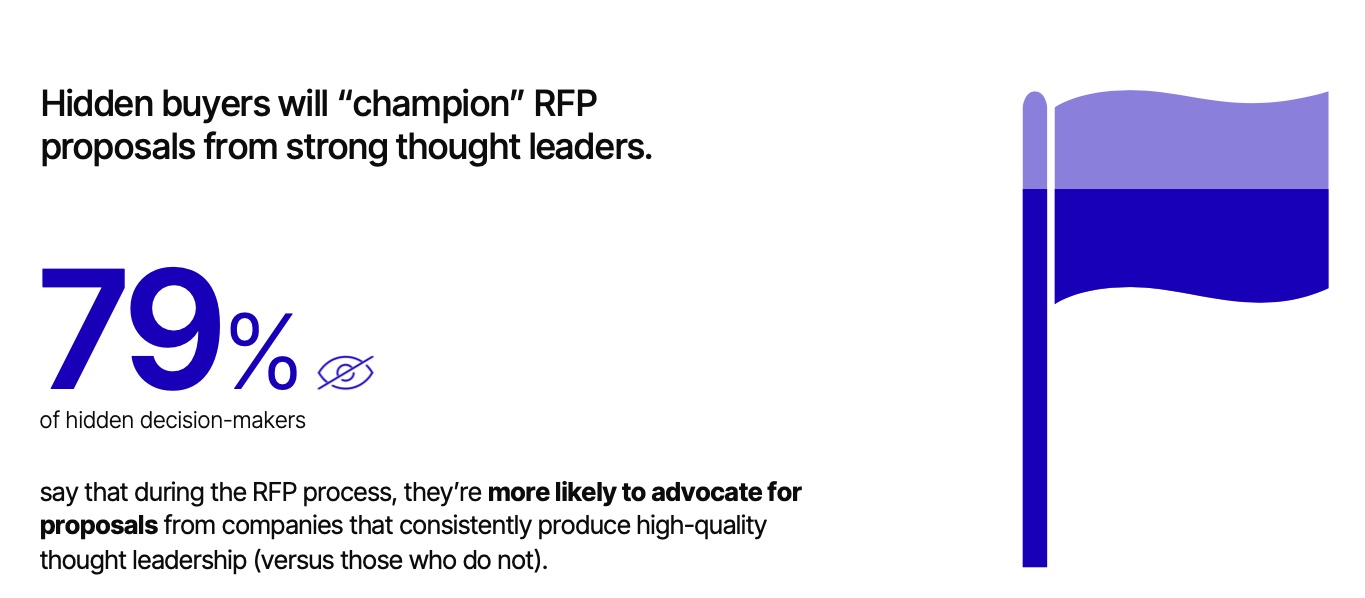
@Edelman-LinkedIn Thought Leadership Impact Report
Going beyond decision makers
In the fast-paced tech and B2B sales arenas, influencing hidden B2B buying influencers has emerged as a key marketing and selling tactic. Reps and marketing folks have traditionally zeroed in on decision-makers but, now, hidden influencers hold powerful sway over buying decisions.
Ever wonder who sways the B2B decision-makers? Beyond the C-suite, IT leads, operations managers, procurement pros, and other unsung influencers hold serious clout in steering the final call.
Think they are passive? Think again!
Hidden buyers may be invisible to sales and marketing but they are anything but passive when it comes to influencing purchase decisions.
Important new findings
In the past 12 months reports from credible sources like Edelman, Momentum ITSMA, DSMN8, Dentsu, Thinkers360, and Forrester paint a very clear picture of what is influencing major purchases in B2B and tech.
For example, the Edelman-LinkedIn B2B Thought Leadership Impact Report reveals that:
- 71% of B2B buyers find thought leadership more effective than traditional marketing
- 91% say it helps them discover challenges of which they were not aware
[Author’s note: Of the nearly 2,000 management-level people surveyed, about 83% were not executive level.]
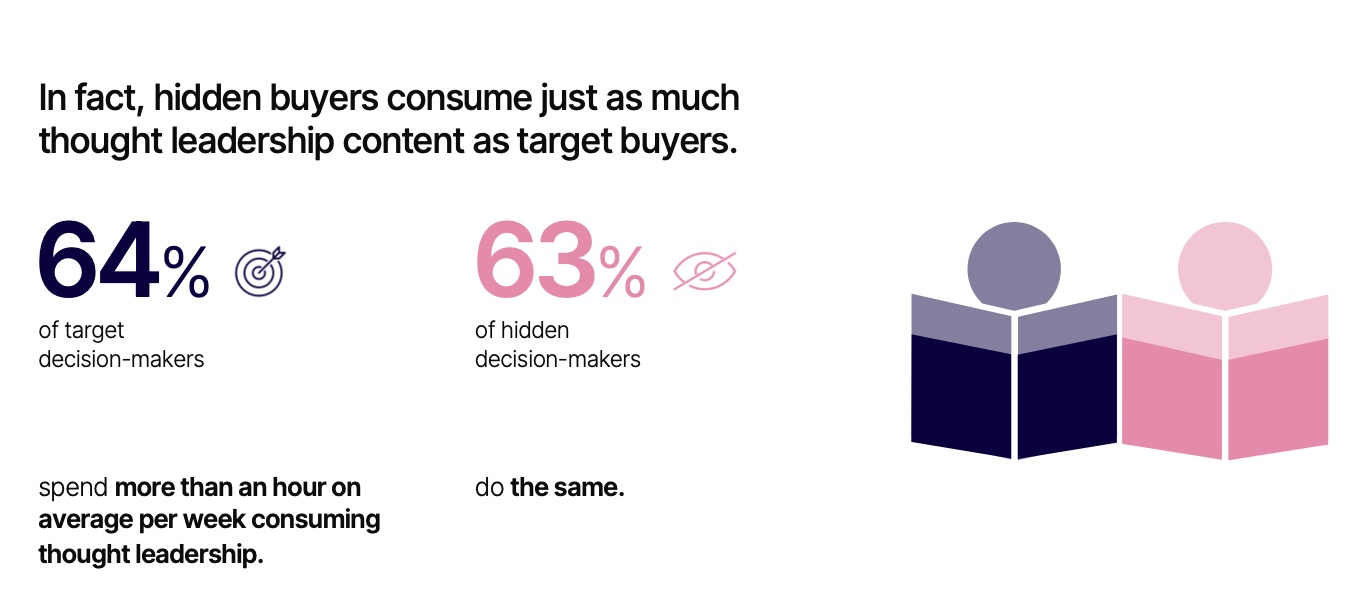
@Edelman-LinkedIn Thought Leadership Impact Report
Hidden B2B Buying Influencers: A Fortune 100 client example
Working through a content agency I recently wrapped a project for a Fortune 100 financial giant, crafting content for a solution that unlocks trapped capital to tackle complex CAPEX financing for automakers.
Initially, I was surprised to learn the white papers, thought leadership article, and other deliverables targeted only procurement executives—not finance, product management, or manufacturing. As the lead writer, I had to immerse myself into procurement’s world, weaving their unique challenges and priorities into a compelling narrative that resonated deeply with their perspective.
Their priorities included:
- certainty of supply
- achieving net zero score 3 emissions in external suppliers
These were not topics I would have normally associated with a financial services solution!
Excerpt from thought leadership article
Additionally, with improved liquidity, suppliers can provide a more reliable and consistent supply of goods and materials. This minimizes supply chain disruptions and ensures goods are available when needed. Well-financed suppliers are critical for minimizing supply chain disruptions.
By providing the necessary capital and incentivizing sustainable practices, internal financing can be a strategic tool for suppliers to achieve net zero emissions, especially in managing the complex and often indirect Scope 3 emissions associated with their value chain.
That is how a $175 billion financial institution is micro-targeting both key decision makers and hidden influencers.
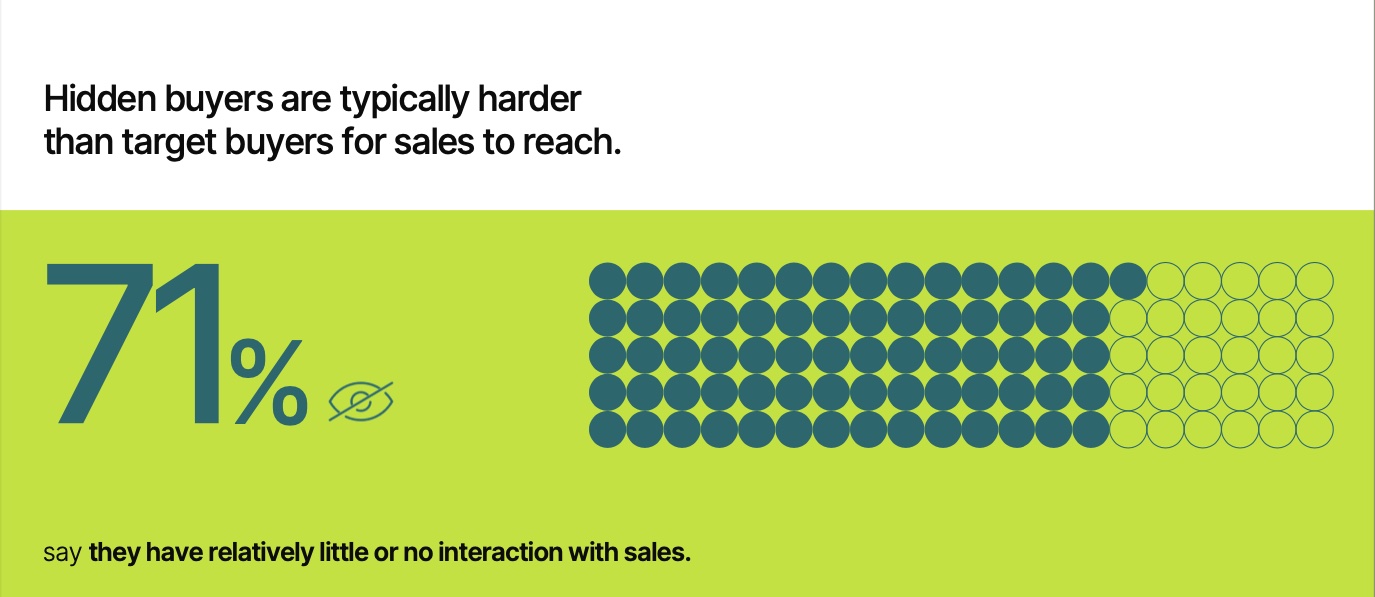
@Edelman-LinkedIn Thought Leadership Impact Report
The hidden buying influencer's role in B2B purchase decisions
How many of those targeted procurement executives gave the white papers— which they received in email campaigns—to trusted subordinates to read and make recommendations? Executive decision makers are relying increasingly on these ‘hidden buyers’ to do the legwork that helps determine ideal solutions, which they can recommend to other executive decision makers with confidence.
Until now tech and B2B sales and marketing teams have largely overlooked hidden B2B buyers. However these clandestine experts exert growing and powerful influence over buying decisions. Legacy tactics like personalized emails with generic messages are a thing of the past for this group. They are savvy and can spot thinly disguised sales pitches and lookalike marketing from miles away.
Why have hidden buying influencers emerged as a critical factor in B2B sales?
Complex sales are stalling across many industries, largely due to customer indecision. For much of business history salespeople have believed that clinging to the status quo was their biggest competitor in a complex sale. But in their book The Jolt Effect, Matt Dixon and Ted McKenna show that, now, customer indecision has surpassed status quo as a salesperson’s biggest competitor.
Customer indecision comes from misalignment among players involved in the purchase decision. To illustrate, procurement may remain undecided because the vendor’s sales and marketing teams failed to address procurement’s priorities. If the key decision makers include the head of procurement, the deal will not happen.
This is why thought leadership aimed at hidden buyers is gaining traction in marketing. If you are selling a multi-million dollar accounting solution to a $10 billion company, it’s almost guaranteed there will be many decision makers and hidden influencers in the mix. They can be discovered and grouped by job titles and priorities.
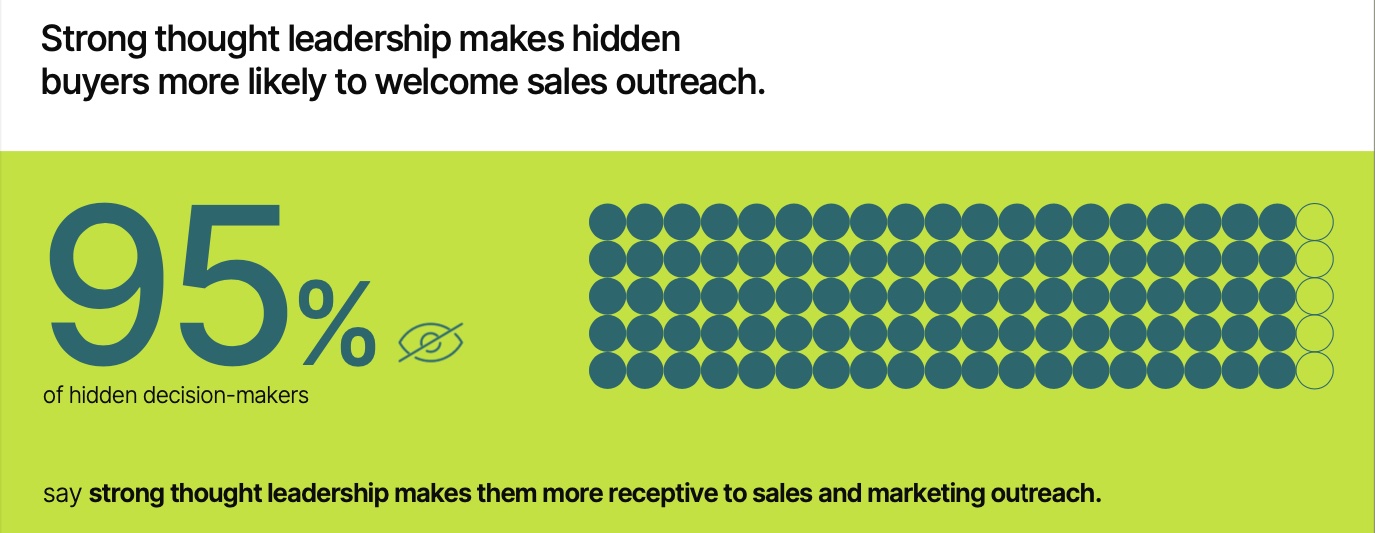
@Edelman-LinkedIn Thought Leadership Impact Report
How do hidden buyers think?
Unlike executives focused on big-picture strategy and execution, these buyers prioritize practical, actionable solutions. If they don’t feel confident in a vendor’s ability to address their specific pain points, they’ll hesitate to champion the solution internally.
A surprising finding from the Edelman-LinkedIn study is that hidden buyers actively discover, consume and evaluate thought leadership just like targeted decision makers. This makes perfect sense because almost everyone has a stake in how a new purchase will affect their job performance even if a decision maker executive hasn’t asked for their thoughts.
This is where discoverable thought leadership for the hidden buyer shines:
- Humans typically value most what they have discovered on their own.
- Niched thought leadership can speak directly to their specific concerns and job challenges.
Unlike traditional marketing, which often prioritizes brand promotion and immediacy, thought leadership focuses on delivering value through expertise, data, examples and real-world relevance. It doesn’t feel like a sales pitch. Instead it provides credible, thought provoking content that speaks directly to individuals’ challenges without feeling like a sales pitch
Example: How Salesforce Does It
High valuation tech firms like Salesforce have long used the power of thought leadership for swaying hidden buyers. Their blog and resource hub offers in-depth guides on topics like:
- “Optimizing CRM for Remote Teams”, clearly created for hidden influencers in sales and marketing who manage people that work remotely.
- “Ensuring Data Security in Multi-Cloud Environments”. In larger companies data security is its own separate function and is quite distant from sales and marketing. Yet IT security people will certainly be included in purchasing decisions for products like Salesforce.
These resources don’t just explain or promote Salesforce’s products—they provide actionable insights that IT managers and operations leads can use to solve real job challenges. By addressing niche challenges, Salesforce builds trust with hidden buyers, who then advocate for their solutions internally. This is a high ROI tactic since there are thousands of other CRM and MAP solutions available at less cost than Salesforce.
Creating thought leadership: the practical guide
For B2B companies creating a content strategy targeting hidden buyers key factors include:
- Identifying – this includes researching job titles, descriptions and hierarchies
- Creating authenticity – you must consume content from a variety of sources that talks about these targeted influences, their jobs and their challenges. Whatever you bring to the table from marketing creative will not work.
- Foregoing the sales and marketing pitch. Remember, these target audiences are not looking for immediacy, pricing or promotion. They’re looking for fresh new insights from subject matter experts that can help them do their jobs better and more efficiently.
A narrated thought leadership article outline
[ARTICLE TITLE – consider using AI for ideas]
Estimated word count: 750–1,000
Resources used: List the documents, websites, articles and other resources where you find insight and data for your article.
Summary
In an era where [fill-in-the-blank] innovation is crucial yet challenging, [target industry] leaders can [fill-in-the-blank] by [fill-in-the-blank]. [Generic solution description] can [insert resolution to problem that your product delivers]. These solutions [insert benefit(s)] while delivering [insert another benefit]. This approach not only [reduces, enhances, saves money/time, etc.] but also positions the [targeted function or department] as a key player in [major company initiative].
Introduction
Theme: Introduce the theme [Fill-In-The-Blank] highlighting the challenges of [describe current condition or circumstances].
1️⃣ Set stage with current statistics:
Introduce the rapid growth of [solutions] valued at $___ billion in 2025 and projected to reach $___billion by 2030, a CAGR of ___%.
This strong growth indicates a significant shift towards using [proposed solution] to [insert benefits].
2️⃣ Briefly discuss the concept of having [proposed solution benefits] within the company. Use a simile or common expression like ‘that’s money!’.
3️⃣ Introduce the problem: Major challenges faced by [job titles] in [industry] include [X, Y, Z]. Ripple effects in other functional areas include [fill-in-the-blank]. Previous investments in [status quo products, solutions or fixes] did not pay off as expected so better solutions are needed.
4️⃣ Tease the solution: Highlight how, with status quo solutions becoming less dependable, companies are increasingly relying on [solutions like ours].
5️⃣ Preview the content to come: Touch on at least 3 key areas.
The Outline
I: The Challenge of [fill-in-the-blank] in the [target] Industry
- Discuss current trends that are causing targeted companies to seek alternative solutions. Show how these trends are impacting dynamics among various parties both inside and outside the organization.
- Highlight the strain on [a particular party] showing impacts that are, preferably, quantifiable.
- Transition: Explain that, with these pressures mounting, rapidly growing solutions such as [your solution] are gaining momentum as practical responses to ease the strain.
II: [Generic Solution]: A Strategic Tool for [fixing the challenge]
- Define generically the solution (do not mention your product or company).
- Explain how [the generic solution] can [insert a benefit] while providing them with [another benefit], thus freeing up [time, money, other…things that cause job anxiety].
- Write about how this [generic solution] can free up resources that be redirected towards [other areas or projects] like in developing [the hot new product in target industry].
- Transition: [Generic solution] can be an essential tool, delivering [blank], [blank] and [blank].
III: Real-World Applications and Benefits
- Address the question: “How can I fix [targeted challenge] and still be in alignment with corporate initiatives and external forces [economic, regulatory, green initiatives, other]?”
- Provide case studies or hypothetical scenarios where [generic solution] has been pivotal in resolving [insert challenge(s)] within the [target] industry.
- Answer: “How does [generic solution] help [job titles] support their organizations in [fixing challenge(s)?”
- Transition: Discuss real-life examples where [job titles] have leveraged these solutions to improve [blank], [blank] and [blank].
IV: The [Targeted Function]’s Leading Role in Choosing [Generic Solution]
- Explore how the [targeted function] can be at the forefront of [company strategy, other] not just a cost center but a source of [insert corporate wide benefit].
- Explain how [generic solution] helps this leadership role by providing [benefit(s)] that align with department and strategic goals.
V: Conclusion and CTA
- Summarize the strategic importance of using [generic solution] to solve the current problem of [insert challenge] deliver [insert benefit(s)]. Encourage [insert job titles] to evaluate [generic solution] to [insert summarized solving of the challenge].
- Example CTA: Learn more at https://www.yourcompany.com/yoursolution/. The CTA on this page can be ‘learn more’, ‘schedule a discovery call’, ‘contact us’, or whatever you like.
In Summary
By crafting thought leadership that speaks directly to hidden influencers like procurement specialists, IT leads, and operations managers, you can transform how B2B deals are won. Start small—audit your content to align with their priorities, weave in authentic narratives, and test your approach with a single campaign.
Let me know if I can help.
Meet Mike Harris
With a robust background in corporate sales and marketing, I bring over 25 years of experience in the tech and B2B sectors. Having navigated roles from management consulting to C-Suite leadership, I have honed my skills in crafting narratives that resonate with tech and B2B audiences.
My career highlights include leading global marketing teams, driving business turnarounds, and developing strategies that address competitive challenges.
Now, as an executive writer, I focus on delivering tailored writing solutions, including whitepapers, thought leadership articles, investor communications and more.
My passion lies in helping businesses tell their stories and achieve their objectives through strategic content creation.
Schedule a Call
Set up a discovery call at a time that works well for you. No charge.
We can chat on the phone or use Zoom, Whatsapp, Google Meet, Facetime, Microsoft Teams or other app.
Send a Message
Quick Links
Top of Page
Home Page